How PEMF Intensity Affects Cellular Response (Why Stronger Is Not Better)
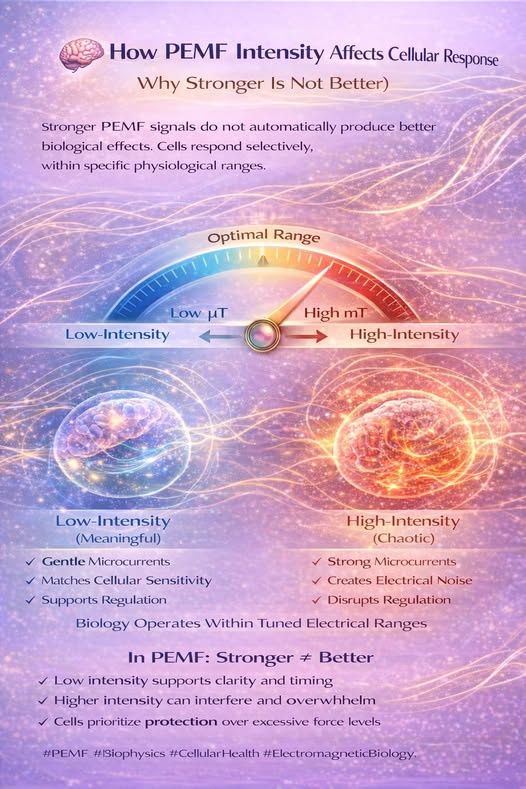
How PEMF Intensity Affects Cellular Response (Why Stronger Is Not Better)
That stronger PEMF signals automatically produce better biological effects.
From a physics and biology standpoint, this assumption is incorrect.
Biology Is Sensitive, Not Force-Driven
Cells do not respond linearly to stronger electromagnetic input.
They respond selectively, within specific physiological thresholds.
Every cell operates within finely tuned electrical ranges. These ranges allow the cell to:
• Maintain membrane potential
• Regulate ion flow
• Coordinate signaling pathways
• Preserve metabolic stability
When external electromagnetic input exceeds what the cell can interpret meaningfully, the biological response does not increase. Instead, the system shifts into protective or compensatory modes.
What Intensity Means in PEMF
PEMF intensity refers to the strength of the magnetic field, usually measured in:
• Microtesla (µT) for low-intensity systems
• Millitesla (mT) for higher-intensity systems
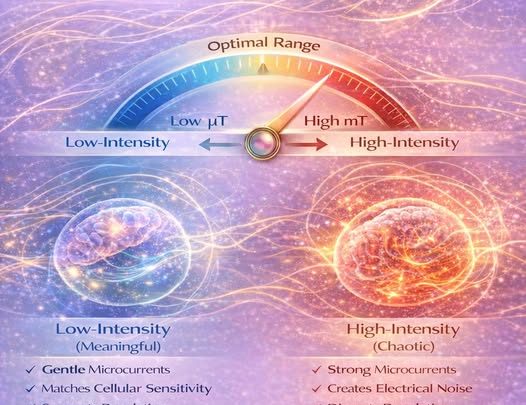
Higher intensity creates stronger induced microcurrents, but stronger does not mean clearer.
In biological systems:
• Excessive intensity increases electrical noise
• Noise interferes with ion channel timing
• Mitochondrial efficiency can decrease
• Cells prioritize protection over adaptation
This is why more force does not equal better regulation.
Lower-intensity PEMF operates closer to the natural electromagnetic background of biological systems.
At appropriate intensities:
• Induced microcurrents remain within physiological ranges
• Cells can interpret the signal without defensive responses
• Electrochemical gradients stabilize rather than fluctuate
• Regulatory pathways remain responsive
Instead of forcing a reaction, the signal supports clarity and timing in existing cellular processes.
Why This Matters Clinically.
This intensity-response relationship explains several observed effects of PEMF:
• Effects are often subtle, not dramatic
• Benefits accumulate rather than spike
• Repeated exposure remains well tolerated
• Long-term use does not exhaust cellular systems
PEMF is not designed to overpower biology.
It is designed to work with biological sensitivity, not against it.
PEMF effectiveness is not defined by how strong the field is.
It is defined by:
• Whether the signal remains interpretable
• Whether it supports regulation rather than disruption
• Whether cells can respond without activating protective shutdown mechanisms
This is why low-intensity, well-designed PEMF systems are often more biologically relevant than high-force approaches.