How Frequency Matters in PEMF
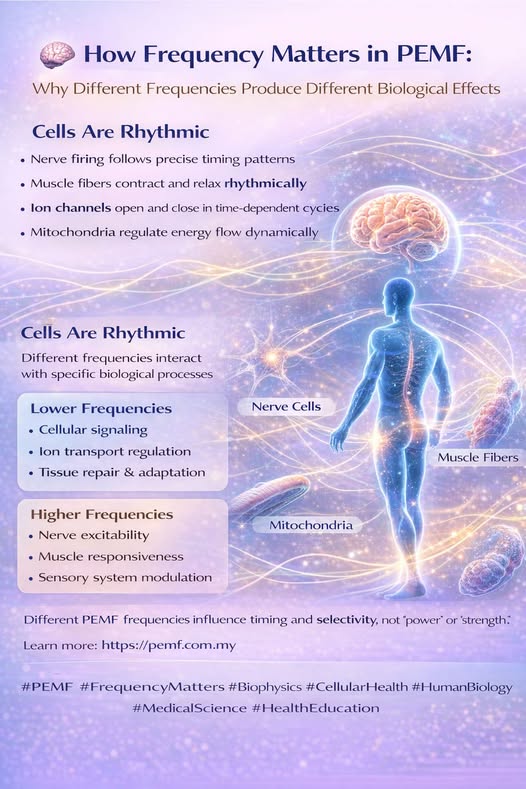
How Frequency Matters in PEMF: Why Different Frequencies Produce Different Biological Effects
In physics, frequency describes how often a signal oscillates over time. In biology, timing is everything. Cells do not respond equally to all signals; they are sensitive to specific ranges of electromagnetic timing that match their physiological processes. This is known as frequency selectivity.
Biology Is Rhythmic, Not Random
Every biological system operates on rhythms:
• Nerve firing follows precise timing patterns
• Muscle fibers contract and relax rhythmically
• Ion channels open and close in time-dependent cycles
• Mitochondria regulate energy flow dynamically
Cells are not passive receivers. They respond when external signals align with their internal timing.
How PEMF Frequency Interacts with Cells
PEMF devices generate electromagnetic pulses at specific frequencies. These frequencies do not increase “power” or “strength.” Instead, they influence which biological processes are most responsive.
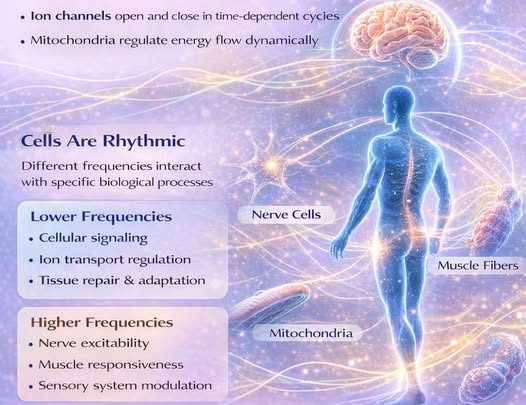
Lower frequencies tend to interact with:
• Cellular signaling pathways
• Ion transport regulation
• Tissue repair and adaptation processes
Higher frequencies tend to interact more with:
• Nerve excitability
• Muscle responsiveness
•Sensory system modulation
This is not stimulation versus non-stimulation.
It is biological selectivity.
A common misconception is that higher frequency means stronger effect.
In reality:
• Frequency determines what responds
• Intensity determines how much force is applied
PEMF systems designed for biological support operate at low intensities, intentionally avoiding forced excitation of nerves or muscles. Instead, frequency is used to match biological timing, not overpower it.
This is why PEMF does not feel dramatic or aggressive, yet produces cumulative effects over time.
Cells, tissues, and systems do not operate on a single rhythm. A well-designed PEMF system uses multiple frequencies to:
• Support different layers of biological regulation
• Adapt to varying tissue responses
• Avoid overstimulation or fatigue
This approach mirrors physiology rather than overriding it.
Frequency in PEMF does not determine how strong the signal feels.
It determines which biological processes are most likely to respond.
This is why PEMF outcomes are gradual, adaptive, and system-wide rather than immediate and localized.