When Medicine Treats the Parts, Who Looks After the Whole Person
When Medicine Treats the Parts, Who Looks After the Whole Person?
I recently came across a story shared by a physician that stayed with me long after I finished reading it.
He wrote something simple, yet deeply thought-provoking:
People are not just a collection of organs.
Over the years, he noticed that some patients required far more time during consultations than others not because their conditions were especially complicated, but because they had seen so many different specialists.
Some patients arrive carrying a thick folder of medical reports.
Orthopedics. Cardiology. Nephrology. Pulmonology. Neurology. Geriatrics.
Sometimes from several different hospitals and clinics.
Before even discussing the patient’s current concerns, the doctor often had to spend time understanding what every previous physician had done, prescribed or recommended.
The story often begins innocently enough.
A patient develops knee pain and visits an orthopedic specialist. An X-ray is taken, pain medication is prescribed and the symptoms improve.
Later, swelling develops in the legs. A cardiology assessment reveals some degree of heart dysfunction, so medications are started to support heart function and reduce fluid retention.
Then kidney function begins to decline, leading to a referral to a nephrologist.
Shortness of breath appears, prompting a visit to a pulmonologist.
Memory concerns lead to a neurology consultation.
Urinary symptoms result in a urology referral.
Mood changes bring psychiatry into the picture.
None of these doctors are wrong.
None of the treatments are inappropriate.
Each specialist is doing exactly what they were trained to do.
Each prescription has a reason.
Each test follows established medical guidelines.
Yet somewhere along the way, something changes.
The patient becomes overwhelmed.
They no longer know how many conditions they have.
They no longer remember what each medication is for.
Every morning, the pill organizer opens to reveal tablets of different shapes and colors, filling an entire bowl.
Retirement was supposed to be about travel, family, hobbies and enjoying life.
Instead, it becomes a schedule of appointments.
Monday: Orthopedics.
Wednesday: Cardiology.
Friday: Nephrology.
Next month: Pulmonology.
Life begins to revolve around managing illness rather than living.
Then come additional opinions, supplements, alternative therapies and well-intentioned advice from every direction.
Everyone wants to help.
Yet the list of appointments grows longer.
The list of medications grows longer.
The list of recommendations grows longer.
Eventually, dizziness develops.
Blood pressure drops.
Balance becomes unstable.
One day, a fall occurs.
A fractured hip leads to hospitalization.
The orthopedic surgeon recommends surgery.
The cardiologist wants further evaluation.
The nephrologist is concerned about kidney function.
The anesthesiologist discusses surgical risk.
The geriatrician notes increasing frailty.
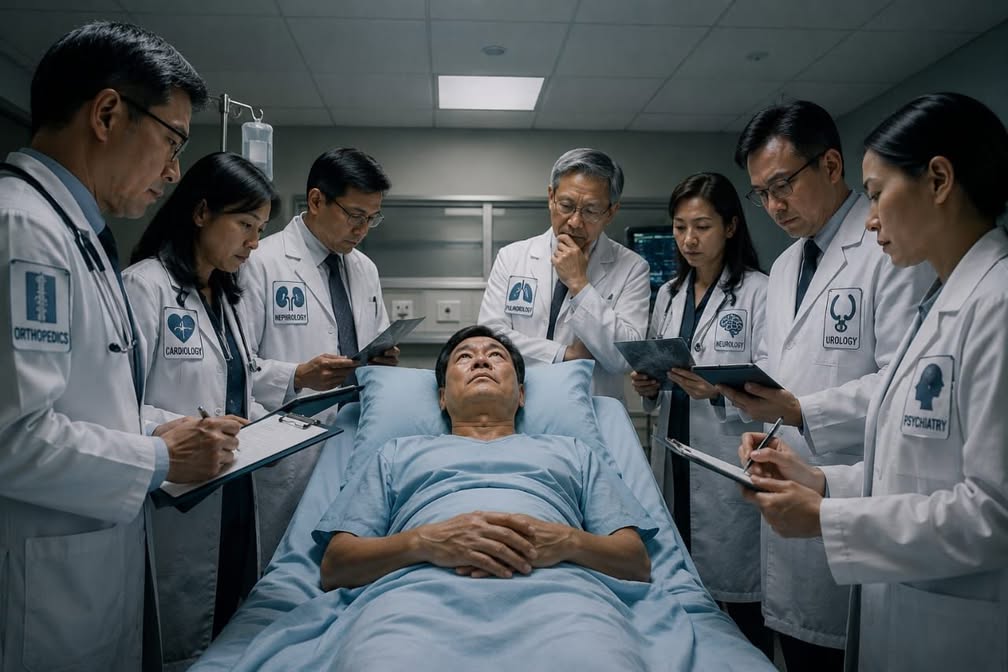
Suddenly, a room full of doctors surrounds the patient’s bed.
Every physician is trying to help.
Every physician is doing their job.
But the patient lies quietly, staring at the ceiling.
The doctor who shared this story admitted that sometimes even he does not have all the answers.
He is simply one part of the same healthcare system.
And he acknowledged two truths that can exist at the same time:
Modern medicine has saved countless lives.
Specialization has dramatically improved healthcare outcomes.
But in the process, we sometimes divide a person into separate systems and organs.
The heart belongs to cardiology.
The kidneys belong to nephrology.
The lungs belong to pulmonology.
The brain belongs to neurology.
Everyone is responsible for an organ.
Yet sometimes it feels as though no one is responsible for the person as a whole.
Because the largest unit in medicine has never been the heart, kidney, lung or brain.
It has always been a living human being.
That story resonated with me.
I am not a doctor.
I do not prescribe medications.
I do not perform surgery.
But it reminded me of an important principle that influences how I think about health and wellness.
Health is rarely about a single pill, a single procedure or a single intervention.
And while treatment is important, prevention and ongoing support are equally valuable.
Supporting the Body as a Whole
One of the tools I share is the iMRS Prime Pulsed Electromagnetic Field (PEMF) System.
It is not a drug.
It is not surgery.
It does not require injections.
It does not require gels or invasive procedures.
It is a non-invasive wellness technology designed to support the body’s natural physiological processes.
Users simply lie on the applicator mat or place a localized applicator over an area of interest while relaxing, reading, or resting.
The pulsed electromagnetic fields pass through clothing and tissue, interacting with the body’s naturally occurring electrical activity.
Important Disclaimer
The iMRS Prime PEMF System is not intended to diagnose, treat, cure or prevent any disease.
Anyone experiencing medical symptoms should seek appropriate medical evaluation and treatment from qualified healthcare professionals.
PEMF therapy should not replace medical advice, prescribed medications or recommended surgical procedures.
Rather, it may be used as a supportive wellness tool alongside appropriate medical care.
The Science Behind PEMF
PEMF technology has been studied for decades, with thousands of scientific publications investigating its biological effects.
Certain PEMF applications have received regulatory clearance in specific medical fields, including:
• Bone growth stimulation
• Post-surgical recovery support
• Certain wound-healing applications
• Management of selected musculoskeletal conditions
The iMRS Prime is also registered with Malaysia’s Medical Device Authority (MDA) as a Class B Medical Device, meaning it has undergone evaluation for safety, performance and quality in accordance with Malaysian regulatory requirements.
This does not mean it is a cure for disease.
It means the technology is recognized as a legitimate medical device platform that meets applicable regulatory standards.
Who May Benefit from PEMF Support?
PEMF is often used by individuals seeking to support overall wellness and recovery, including:
• People recovering from surgery or injury
• Individuals experiencing chronic musculoskeletal discomfort
• Those seeking better rest and recovery
• Individuals with slow healing processes
• People focused on proactive health maintenance and healthy aging
Every individual is different and outcomes vary.
How Is It Used?
Usage is simple.
Most people use the system for approximately 20–30 minutes per session, once or twice daily.
No recovery time is required.
No special preparation is needed.
Many users simply relax while the session runs.
Why Many People Appreciate PEMF
One reason PEMF continues to attract attention is that it does not focus on a single organ.
Instead, it works at the level of cellular function.
Every organ in the body is made of cells.
The heart contains cells.
The kidneys contain cells.
Bones contain cells.
Muscles, nerves, blood vessels, and connective tissues all contain cells.
PEMF research suggests that electromagnetic stimulation may influence cellular electrical activity, support microcirculation and help maintain normal physiological processes.
Rather than targeting a single body part, the goal is to support the body’s overall environment for recovery and function.
Key Advantages
Drug-Free
No medications to swallow.
No concerns about drug interactions.
No additional burden on the liver or kidneys.
Non-Invasive
No surgery.
No needles.
No wounds.
No recovery period.
Comfortable to Use
Most users simply relax during a session.
Can Complement Existing Care
PEMF is commonly used alongside conventional healthcare rather than as a replacement for it.
Will PEMF guarantee results?
No.
No responsible healthcare professional should promise that.
What it may do is provide the body with additional support while the body’s own healing and recovery processes take place.
Because health is not just about a heart, a kidney, a knee or a spine.
Health is about the entire person.
And sometimes, supporting the whole person matters just as much as treating the individual parts.
That is why I continue sharing the iMRS Prime system.
Not because it replaces medicine.
Not because it replaces doctors.
But because it offers a non-invasive, drug-free way to support the body’s natural ability to recover, adapt and function at its best.
After all, the goal is not simply to treat organs.
The goal is to help people live better lives.
For more information:
Contact us anytime, we are just a Phone Call away to assist you!
Or simply just WhatsApp us now at +60166559494