How PEMF Influences Cellular Energy Production
How PEMF Influences Cellular Energy Production (ATP & Mitochondria)
Every biological process in the body depends on ATP (adenosine triphosphate). ATP is the energy currency used for muscle contraction, nerve transmission, protein synthesis, tissue repair, and active transport across cell membranes. Without sufficient ATP, cells can survive, but they cannot function efficiently.
ATP is produced primarily inside the mitochondria. This process is not purely chemical. It is electrochemical in nature and depends heavily on the electrical and ionic environment of the cell.
The Electrical Nature of ATP Production
Mitochondria generate ATP through a process known as oxidative phosphorylation. At its core, this process relies on:
• A stable membrane potential
• Proper ion gradients, especially proton (H⁺) gradients
• Efficient electron transport along the mitochondrial membrane
The movement of electrons through the electron transport chain creates an electrochemical gradient. This gradient drives ATP synthesis. In other words, energy production depends on electrical order.
When cells are exposed to chronic stress, inflammation, injury, reduced circulation, or aging, this electrical order becomes disrupted. Mitochondria do not stop working, but they become less efficient, producing less ATP while consuming more resources.
This leads to a common biological pattern:
• Higher energy demand
• Lower energy efficiency
• Slower recovery and adaptation
Where PEMF Interacts
PEMF does not inject energy into cells.
PEMF does not “charge” ATP molecules.
Instead, PEMF interacts with the conditions mitochondria depend on.
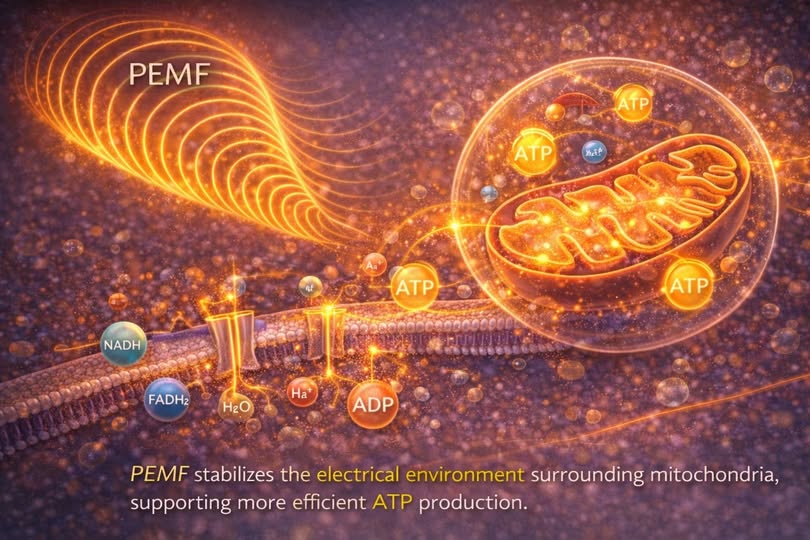
Through electromagnetic induction and subtle modulation of membrane potential, PEMF can:
• Support stable electrochemical gradients
• Improve ion flow efficiency around mitochondrial membranes
• Reduce electrical instability that interferes with energy transfer processes
By stabilizing the electrical environment surrounding the cell and its organelles, mitochondria are better able to perform their normal function. ATP production becomes more efficient, not forced.
Why This Matters Clinically?
When ATP availability improves:
• Cells respond to signals more effectively
• Repair processes proceed with less delay
• Tissues tolerate stress better
• Recovery becomes more sustainable
This is why PEMF effects are often described as gradual and cumulative, rather than immediate. Energy systems do not shift instantly. They adapt over time as efficiency improves.
PEMF is not an energy booster in the conventional sense.
It does not override fatigue or artificially stimulate metabolism.
Instead, it supports the biophysical conditions required for efficient energy production, allowing cells to meet demands with less strain.
This is also why PEMF can be used repeatedly and long-term, it supports regulation, not forced output.