Why Modern Life Doesn’t Break The Body, But Slowly Drains It
Why Modern Life Doesn’t Break The Body, But Slowly Drains It
Most health changes don’t happen suddenly. They accumulate quietly, over time.
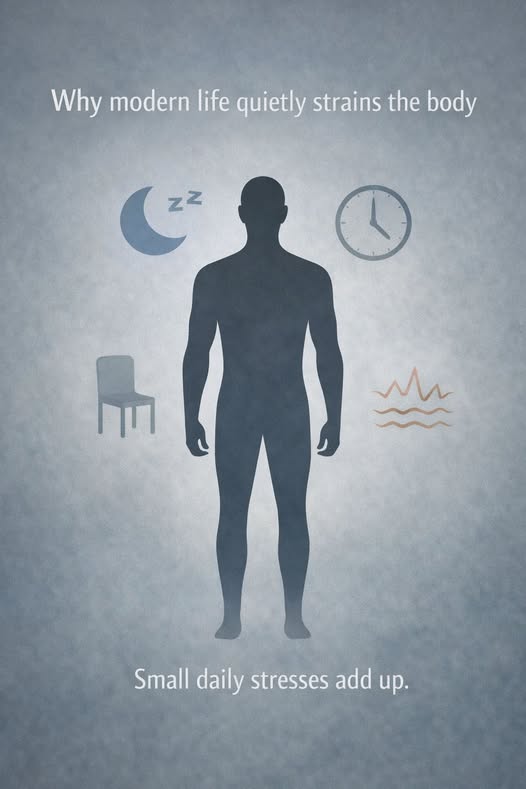
Modern life places continuous low-level demands on the body:
• Ongoing psychological stress
• Irregular or insufficient sleep
• Long periods of sitting
• Repeated low-grade inflammation
• Constant cognitive load
None of these immediately cause disease.
Instead, they gradually reduce how efficiently the body can:
• Maintain balance
• Coordinate internal processes
• Recover between demands
The body adapts, and for a long time, adaptation works.
But over time, adaptation becomes strain.
This is why many people describe experiences like:
“I’m functioning, but I don’t feel optimal.”
“I’m tired, but all my tests are normal.”
“Recovery feels slower than it used to be.”
These experiences are not imagined.
They reflect gradual changes in how the body manages physiological load.
Health is not only about avoiding illness.
It is also about how well the body sustains balance under daily demands.